
Herniated Disc Relief in Georgetown & Taunton, MA
Our chiropractic care for herniated discs relieves nerve irritation, reduces muscle guarding, and restores spinal mechanics — helping you move with less pain and more confidence, without surgery.

A Herniated Disc Is Painful — But Often Very Treatable
A herniated disc occurs when the soft, gel-like inner material of an intervertebral disc pushes through its outer shell. This can compress nearby nerve roots — producing sharp local pain, radiating pain into the leg or arm, numbness, tingling, or weakness. Lumbar disc herniation (low back) is most common, though cervical disc herniation (neck) is also frequently seen.
Most patients assume surgery is inevitable. Research tells a different story: the majority of herniated disc cases respond well to conservative chiropractic care, and most herniations naturally reduce in size over time when given the right mechanical and lifestyle environment to heal.
The Problem
Disc herniation compresses nerve roots, triggering radiating pain, numbness, and weakness. The surrounding muscles guard and tighten, joint mechanics deteriorate, and repeated poor loading — lifting, sitting, bending — keeps the nerve inflamed and prevents healing.
The Solution
Chiropractic care restores the mechanical environment around the disc — reducing nerve compression, improving joint motion, and building the core stability that prevents re-injury. Combined with load management coaching, most patients avoid surgery and return to full activity.

Why a Herniated Disc Hurts — and Why Conservative Care Works
Each spinal disc acts as a shock absorber between vertebrae. When a disc herniates, the inner nucleus pulposus pushes through the fibrous outer annulus — compressing the adjacent nerve root and triggering a local inflammatory response. This is what causes the characteristic combination of local back or neck pain plus radiating pain, numbness, or weakness along the nerve's path.
Chiropractic care doesn't "put the disc back in" — but it does something equally important: it improves joint mechanics around the affected segment, reduces the mechanical load on the disc, and creates the conditions your body needs to naturally resorb the herniated material over time.
- Research in BMJ Open (2022) found patients receiving chiropractic care for lumbar disc herniation had significantly reduced odds of surgery at 2 years compared to other conservative approaches
- Lumbar disc herniations most commonly occur at L4–L5 and L5–S1 — the same levels that produce sciatic pain radiating into the leg
- Cervical disc herniations at C5–C7 produce arm pain, weakness, and hand tingling that are frequently mistaken for shoulder or elbow conditions
- Core endurance deficits and poor hip hinge mechanics are major contributors to recurring disc stress — and key targets of our rehab approach
- Most disc herniations naturally reduce in volume over 6–18 months — chiropractic care supports this process by optimizing spinal mechanics throughout
Disc Mechanics & Degeneration
Repeated poor loading — sustained forward bending, improper lifting, prolonged sitting — compresses the disc unevenly over time. Combined with age-related dehydration of disc material, this creates the conditions for herniation at the most vulnerable spinal levels.
Nerve Root Compression
When herniated disc material presses on a nerve root, it triggers an inflammatory cascade that produces pain, altered sensation, and sometimes weakness along the nerve's entire pathway — into the leg (sciatica) or arm. Reducing this compression is the primary goal of care.
Core Stability Deficits
Weak or poorly timed deep spinal stabilizers — the multifidus, transverse abdominis, and pelvic floor — allow the spine to absorb impact and load poorly. Without targeted rehabilitation, the disc is re-stressed with every movement, prolonging recovery and increasing recurrence risk.
A Clear, Step-by-Step Plan to Reduce Pain and Restore Motion
We begin by confirming whether your pain is disc-related — and exactly which level and structure is involved. From there, care is built entirely around your specific findings, your lifestyle, and your goals.
Thorough Evaluation
Postural analysis, lumbar and cervical range of motion, orthopedic and neurological testing (including reflex, dermatomal, and myotomal assessment), and a full symptom history. X-rays or MRI are coordinated when clinically indicated.
Diagnosis & Education
Dr. Ryan explains exactly which disc is involved, what's compressing the nerve, and what your realistic recovery timeline looks like — in plain language. Imaging is reviewed in detail, as patients tell us this is often the most thorough explanation they've ever received.
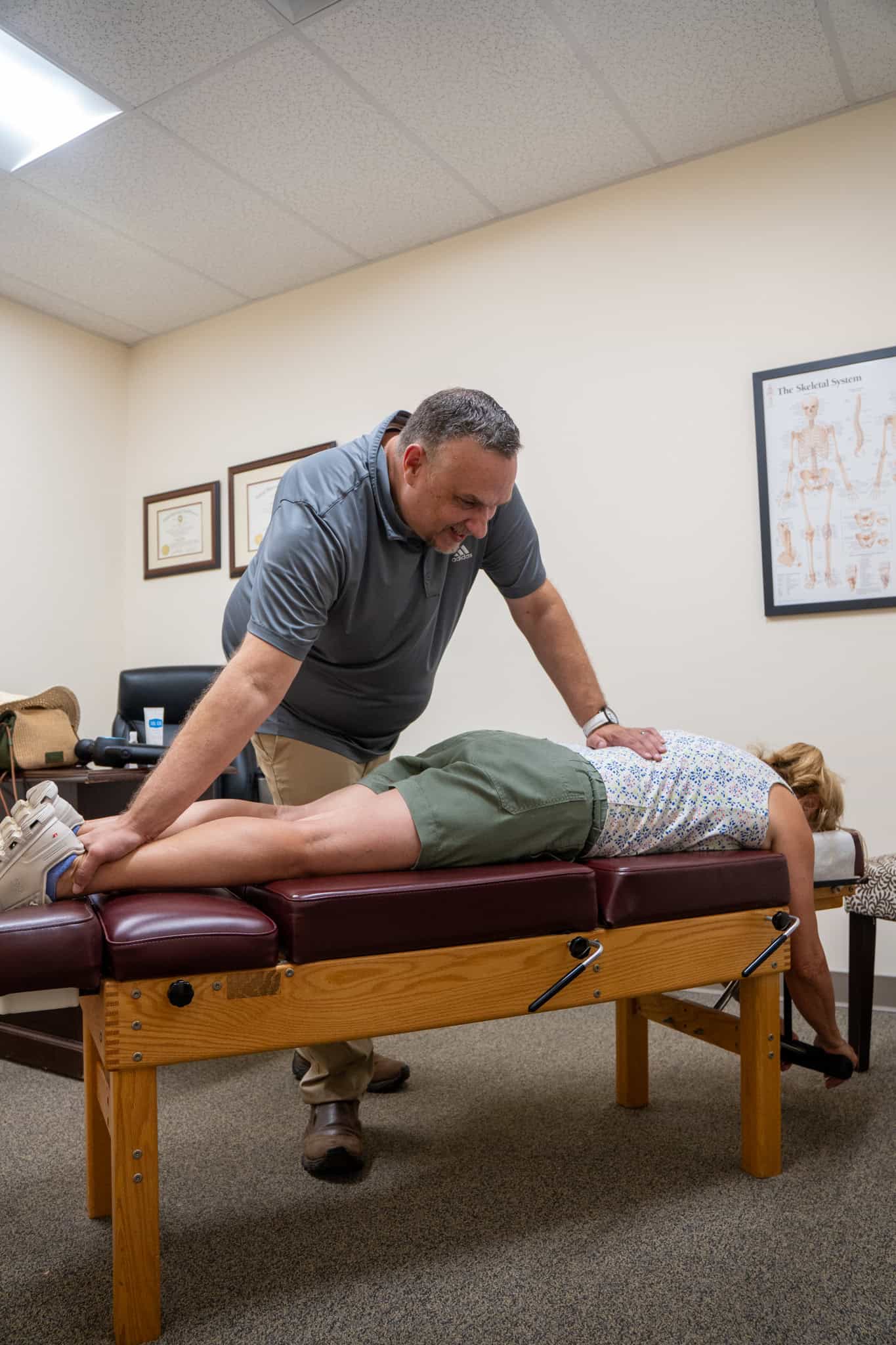
Hands-On Treatment
Segmental adjustments or mobilization matched to your tolerance, soft-tissue release for guarding muscles, and early-stage directional exercises to reduce nerve tension and support disc healing.
Stabilization & Prevention
Progressive core stabilization, hip hinge mechanics, and load management coaching ensure you can return to full activity — and stay there — without relying on passive treatment alone.
Conservative Care That Creates the Conditions for Healing
Chiropractic care for disc herniation focuses on restoring the mechanical environment — not manipulating the disc directly. By improving joint motion around the affected segment, we reduce the compressive and inflammatory forces keeping the nerve irritated and the disc under stress.
A 2022 study in BMJ Open found that patients receiving chiropractic adjustments for lumbar disc herniation had significantly reduced odds of surgery at 2 years — making early conservative care one of the most evidence-supported approaches available.
Segmental Mobilization
Precise, graded joint mobilization reduces restriction above and below the affected disc without high-force techniques at the painful level.
Directional Preference
McKenzie-based directional exercises are prescribed to "centralize" radiating pain — often producing noticeable improvement within days.
McGill Core Stabilization
The Big 3 (curl-up, side bridge, bird dog) and progressive hip work protect the disc during recovery and prevent re-injury.
Hip Hinge & Load Training
Teaching safe lifting, bending, and daily movement mechanics removes the repeated micro-stress that keeps the disc herniation from healing.
Three Pillars of Herniated Disc Recovery
Adjustments reduce nerve irritation — but combining them with core stabilization and load coaching is what prevents recurrence and eliminates the need for repeated passive treatment. Here's how we build your complete plan.
Chiropractic Adjustments
Segmental adjustments and mobilization restore joint mechanics around the herniated disc — reducing nerve irritation, relieving muscle guarding, and improving the disc's mechanical loading environment.
Core Stabilization & Rehab
McGill Big 3 progressions, directional preference exercises, hip activation, and neural mobilization build the spinal stability that protects the disc during activity and prevents re-injury.
Ergonomics & Load Coaching
Lifting mechanics, sitting posture, sleep position, and driving habits — practical daily changes that reduce the cumulative disc stress keeping your nerve irritated and your pain persistent.
Who We Help
Herniated discs occur across all ages and activity levels. Dr. Ryan treats a wide range of presentations at our Georgetown and Taunton offices.
Desk Workers & Sedentary Lifestyles
Prolonged sitting increases intradiscal pressure and compresses lumbar structures asymmetrically over time. Many disc herniations are the end result of years of poor sitting posture and insufficient movement — both correctable with the right care.
Manual Workers & Laborers
Repeated lifting, twisting, and sustained forward flexion create the mechanical conditions for disc injury. We address the root loading pattern — not just the acute pain — and teach safe movement mechanics for return to work.
Athletes & Active Adults
Lifting injuries, contact sport trauma, and repetitive loading patterns all contribute to disc herniation. We get you back to training safely — and Susan DiResta's story below shows what's possible with the right care and consistency.
Post-Imaging: MRI Confirmed Herniation
If you've had imaging confirming a disc herniation and been told surgery may be necessary, chiropractic care is a well-supported first-line conservative option. We review your imaging in detail and explain exactly what it means for your treatment.
Middle-Aged & Older Adults
Degenerative disc disease and age-related disc thinning increase herniation risk — but gentle mobilization, core training, and movement coaching produce excellent results even in complex, long-standing cases.
Avoiding or Recovering from Surgery
Whether you're trying to avoid disc surgery or recovering from a procedure, conservative chiropractic care and rehabilitation support optimal outcomes. We coordinate with your surgical team when involved and provide thorough documentation throughout.
"I've been going to Ryan Chiropractic for over 6 months and have had amazing results. Before, my lower back was incredibly stiff and my hip alignment was visibly off. I am now able to run and work out without pain or severe stiffness. Friendly office and easy to book with their online portal!"
Susan's outcome — running and working out pain-free after months of stiffness and hip misalignment — reflects exactly what's possible when disc and joint problems are addressed consistently with the right combination of adjustments, core work, and ergonomic changes.
Read All Reviews → 📅 Book NowHerniated Disc Chiropractic Care FAQ
Still have questions? Call us at (978) 352-4200 or visit our new patient page.
Relieve Disc Pain and Restore Your Motion
We'll build a personalized plan — nerve pain relief first, then core strength and load coaching for lasting results. Serving Georgetown, Taunton, and surrounding Massachusetts communities since 2005.