

March 2026 • Week 2
Why Pain Is Often Felt Somewhere Else
Last week we discussed an important concept: pain is a warning signal, not necessarily the problem itself.
This week we will take that idea one step further.
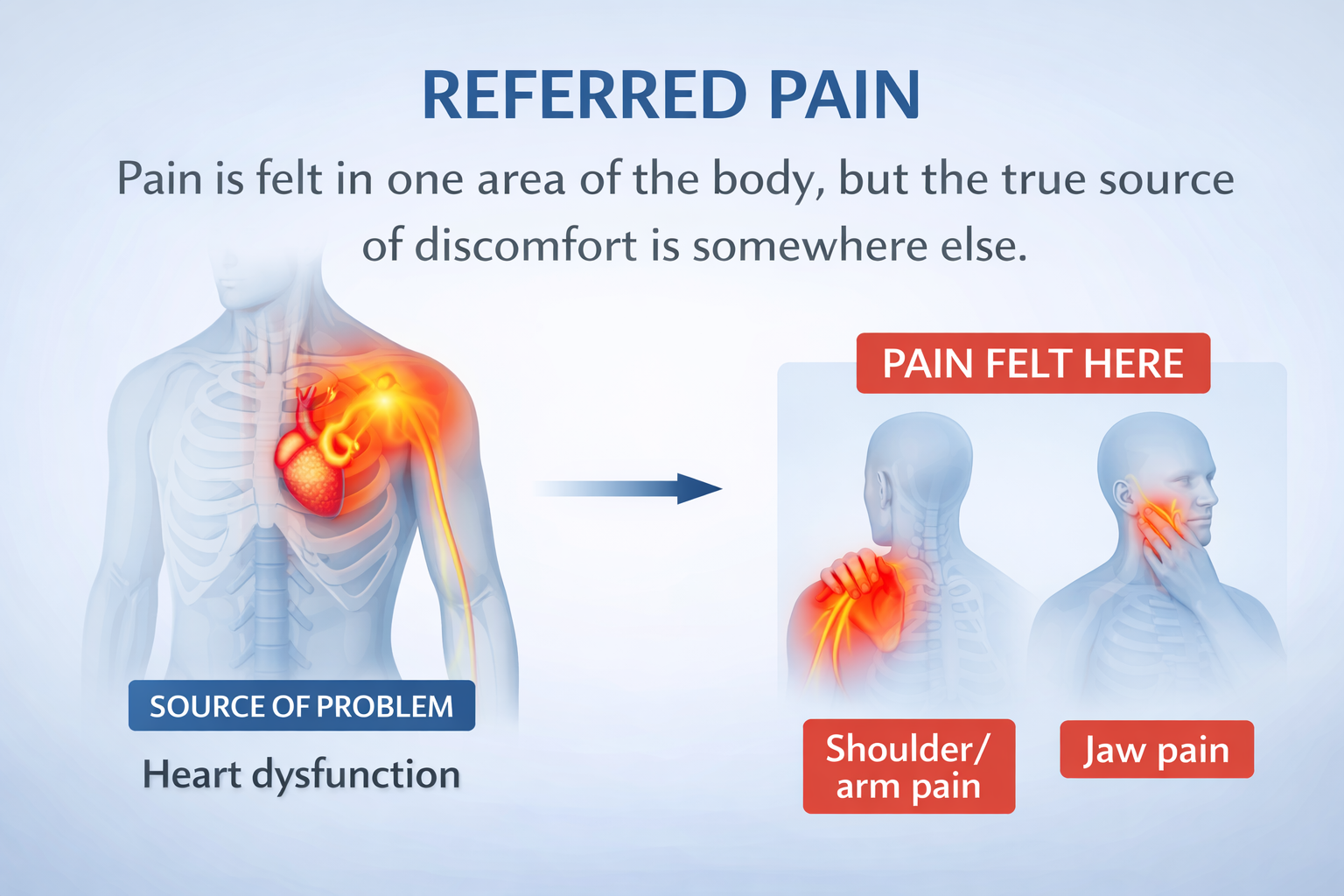
The place you feel pain is not always the place where the real problem started.
In healthcare, this phenomenon is called referred pain — when discomfort is felt in one area of the body even though the true source of the stress is somewhere else. Learn more about referred pain here.
A Common Example: The Sciatic Nerve
Many people experience pain traveling down the leg and assume the problem must be in the leg itself.
But in many cases, the irritation is actually occurring in the lower back where the sciatic nerve originates.
When pressure or inflammation affects that nerve near the spine, the signal travels along the nerve pathway. The result can be pain, tingling, or numbness felt in the hip, thigh, or even the foot (Sciatica).
The leg hurts, but the underlying issue may be higher up the chain.
Another Example: Headaches and the Neck
Headaches are another situation where the source is often misunderstood.
Many headaches are related to tension and mechanical stress in the upper neck and surrounding muscles. Long hours at a computer, poor posture, or restricted movement in the cervical spine can contribute to irritation that the brain perceives as head pain.
In these cases, treating only the head may miss the real source of stress.
Why This Matters
When treatment focuses only on the location of pain, the underlying issue may remain unchanged.
That is one reason many people experience recurring flare-ups. The symptom is addressed, but the mechanical stress that produced the signal continues.
Understanding how the body is connected allows us to ask a better question:
Where is the stress really coming from?
A Function-Based Approach
At Ryan Chiropractic Wellness , we focus on identifying the areas that are not moving or functioning properly, even if they are not the area that hurts the most.
- Spinal mobility
- Joint alignment and mechanics
- Postural stress patterns
- Muscle balance and stability
- Movement efficiency
When these underlying factors improve, the nervous system often stops sending the pain signal.
Again, the goal is not simply to reduce symptoms.
The goal is to restore proper function.
Where Do You Start?
Our care plans are structured to meet people where they are in their health journey.
Restore
Designed for individuals currently experiencing pain or flare-ups.
Enhance
Focused on correcting underlying imbalances and improving resilience.
Thrive
Long-term wellness and prevention through consistent care.
Pain may appear in one place, but health is built through improving how the entire system functions.
This Week’s Takeaway
If pain keeps returning in the same area, the real question may not be “how do I treat this spot?”
Instead ask:
What part of the system is causing the stress?
In Week 3, we will explore why movement and stability play such an important role in preventing recurring pain.