

February 2026 • Week 4
Desk Setup, Sitting Time, and School Posture
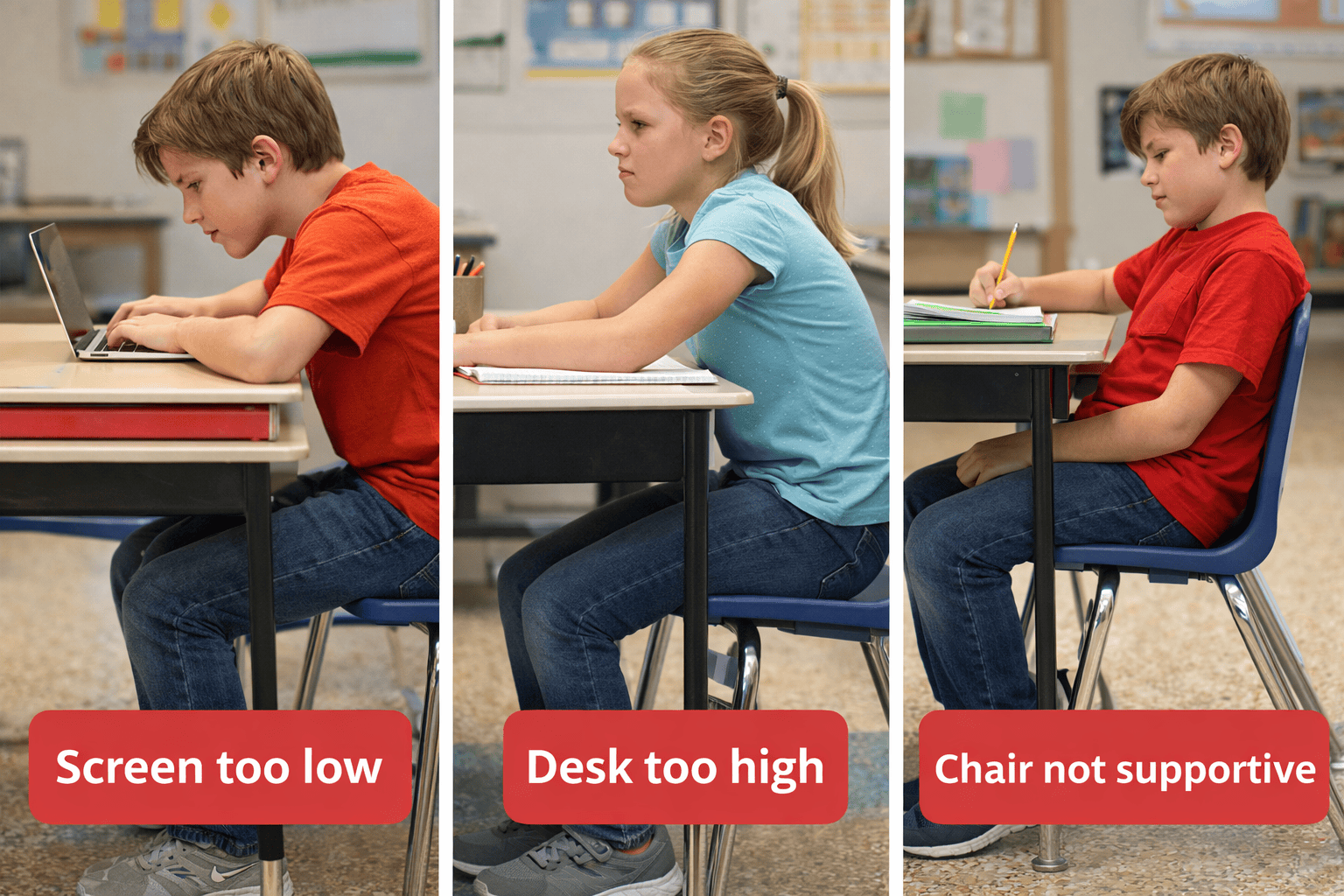
Even if backpacks are the right weight and screens are limited, there is another daily posture stressor that adds up fast: long school days of sitting in desks that rarely match a growing body.
Why sitting posture matters more than most parents think
Kids do not sit for 30 minutes. They sit for hours. When the desk, chair, and screen are not positioned well, the body adapts to get through the day. Over time, those adaptations can become “default posture.”
The American Academy of Pediatrics encourages families to pay attention to screen setup and habits, not just screen time (source).
3 common school posture problems we see
- Screen too low: Laptops and tablets on a desk encourage forward head posture and rounded shoulders.
- Desk too high: Shoulders elevate or arms reach forward, increasing neck and upper back tension.
- Chair not supportive: Feet dangle or the child slouches to feel stable, especially during growth spurts.
Simple desk setup targets for kids
You do not need a perfect setup. You need a workable setup that reduces strain and encourages movement. Use these simple targets at home for homework and screens:
- Feet supported: Feet flat on the floor, or on a box or footrest if the chair is too high.
- Hips and knees: Roughly 90 degrees, with the child able to sit back without sliding forward.
- Elbows close: Forearms supported on the desk so shoulders can relax.
- Screen height: Top third of the screen closer to eye level when possible (use a stand plus external keyboard for laptops).
The missing piece: movement breaks
Even an ideal posture becomes stressful if it is held too long. The spine and nervous system do better with frequent, small posture changes.
A practical target for most kids is a brief movement break every 30 to 45 minutes during homework or screen time. Stand up, stretch, walk, or do a short mobility drill.
A quick “reset” you can do at home
- Wall posture check (30 seconds): Heels near the wall, back and head gently touching, breathe slow, relax shoulders.
- Chin tuck (5 reps): Slide the head back without looking down, then relax.
- Scap squeeze (10 seconds): Lightly pinch shoulder blades back and down, then release.
These are not about forcing perfect posture. They are about giving the body a neutral reference point and restoring mobility after sitting.
If your child regularly complains of neck or back tightness, slouches at the desk, or seems uneven after long school days,
it may be a sign their body is compensating under daily load.
Schedule a Child Posture & Movement Evaluation
Forward to Family or Friend