

February 2026 • Week 3
Backpack Weight and a Growing Spine
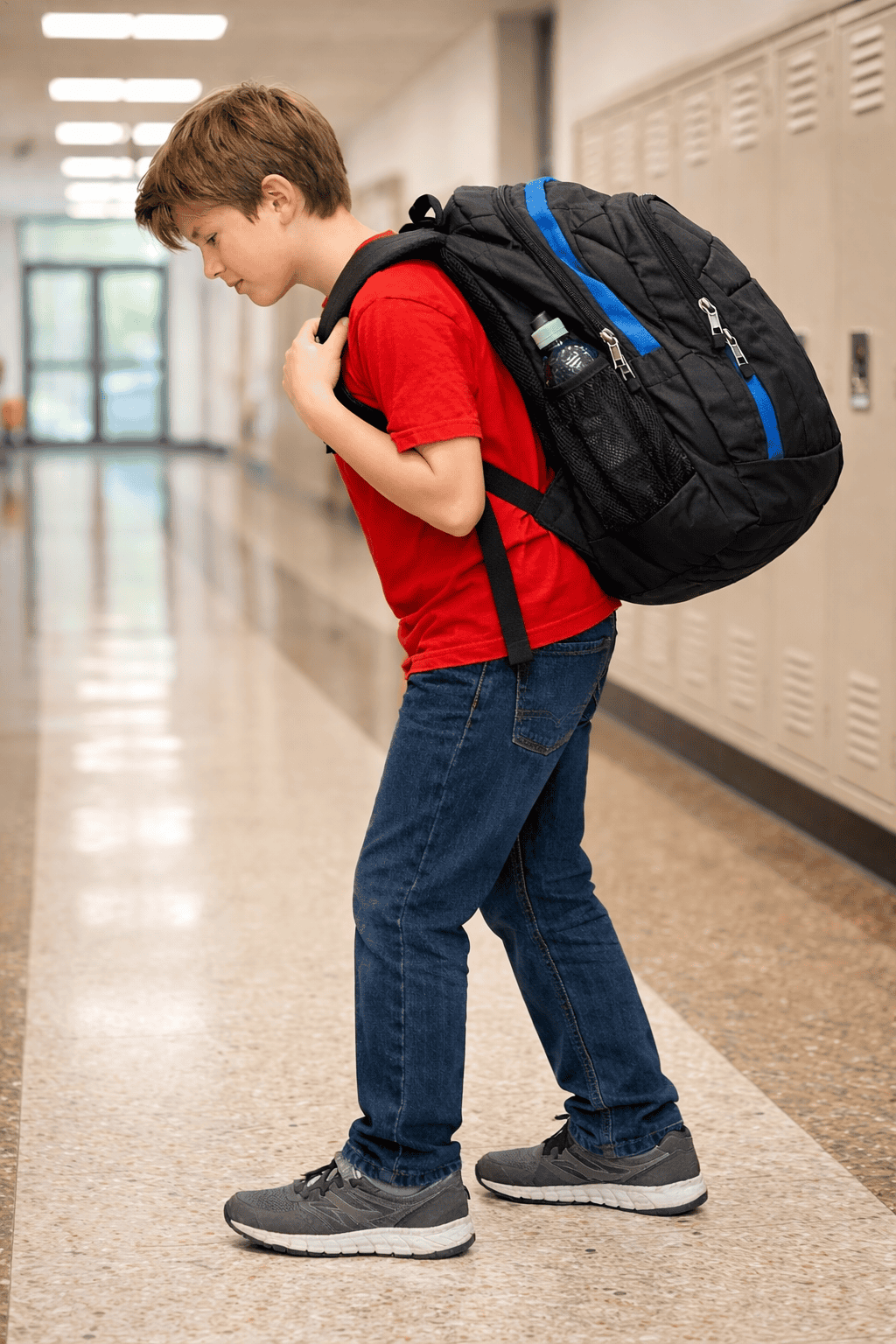
Backpacks are a daily reality for most kids. What often goes unnoticed is how much weight they carry and how that load influences posture while the spine is still developing.
How heavy should a backpack actually be?
Multiple health organizations agree that backpack weight should be limited to a percentage of a child’s body weight rather than a fixed number.
- Elementary-aged children: No more than 10 percent of body weight
- Middle school students: 10 to 15 percent of body weight
- High school students: Aim to stay under 15 percent of body weight
These recommendations are supported by the American Academy of Pediatrics and the American Chiropractic Association (source, source).
Why backpack weight matters more during growth
During growth spurts, bones lengthen faster than muscles and connective tissue can adapt. This temporarily reduces stability and makes posture more sensitive to load.
When a backpack is too heavy, the body often compensates by:
- Leaning the upper body forward to counterbalance the weight
- Pulling the head forward, increasing neck strain
- Rounding the shoulders to support the load
- Shifting weight unevenly when straps are not worn properly
Over time, these compensations can become habitual posture patterns, especially when combined with prolonged sitting and screen use.
What research shows about heavy backpacks and posture
Studies show that excessive backpack loads are associated with changes in gait in seven year olds. (source).
While a heavy backpack does not automatically cause injury, it increases daily stress on a growing spine that is already adapting to school, screens, and sitting.
Simple steps parents can take this week
- Weigh your child’s backpack at home and compare it to their body weight
- Encourage wearing both shoulder straps, snug but comfortable
- Remove unnecessary items at the end of each school day
- Choose backpacks with padded straps and waist or chest support when possible
These small adjustments reduce unnecessary load and help the body maintain more balanced posture during growth.
Backpacks, screens, and sitting all place demands on a developing spine.
Monitoring load early allows posture to adapt in healthier ways over time.
Schedule a Child Posture & Movement Evaluation
Forward to Family or Friend