

May 2026 • Week 1
Why Yard Work Hurts More Than You Think
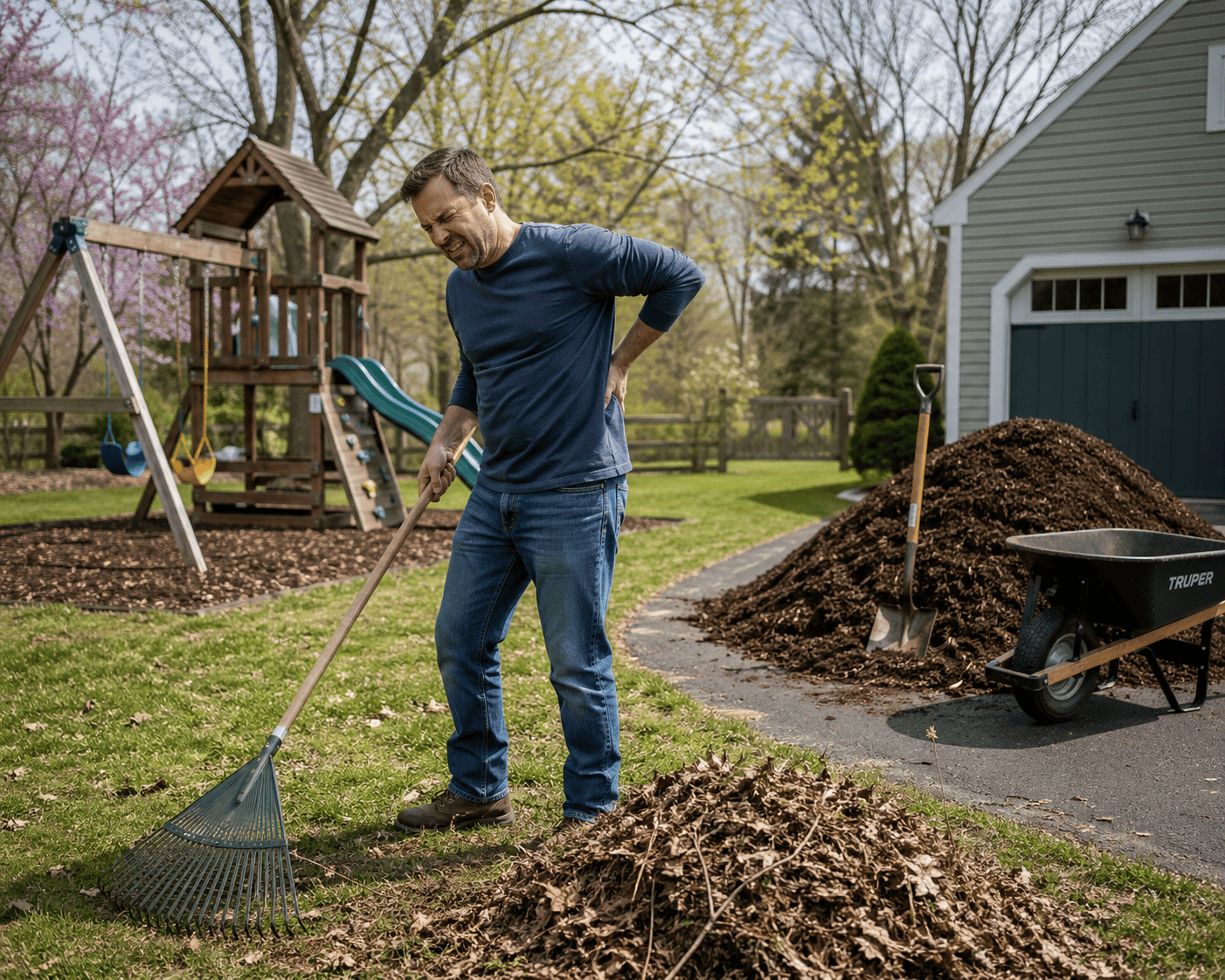
Every spring, the same pattern plays out. The weather breaks, the yard needs attention, and people spend a full weekend raking, mulching, planting, and hauling. By Monday, the lower back is screaming.
It is not a mystery. It is mechanics.
Why Yard Work Hits Differently
Yard work is physically demanding in a way most people underestimate — not because any single movement is extreme, but because of the combination: sustained bending, repetitive twisting, asymmetrical lifting, and prolonged awkward positions, repeated for hours at a stretch.
Add in a winter of reduced activity and muscles that have spent months doing less, and the body is simply not ready for the load spring asks of it.
- Raking keeps the spine in a forward-flexed position for long periods
- Mulching and planting involve repeated bending and rising — the motion most likely to trigger lower back strain
- Hauling bags and equipment loads one side of the body more than the other
- Kneeling and getting up from the ground stresses the hips and knees in ways the body has not done recently

Sore Muscles vs. Something More Serious
Some discomfort after a physically demanding day is normal. Muscles that were not being used heavily will feel it. That kind of soreness typically peaks 24–48 hours later and fades within a few days.
Signs that it may be more than muscle soreness:
- Pain that shoots into the glutes, hip, or down the leg
- Sharp pain with specific movements like bending forward or standing up
- Pain that is worse in the morning and does not ease with movement
- Numbness, tingling, or weakness in the leg or foot
If any of those are present, the body is signaling something beyond typical soreness. That is worth addressing sooner rather than waiting it out.
Simple Habits That Reduce the Risk
- Hinge at the hips, not the lower back. When picking something up, push the hips back and keep the spine long rather than rounding forward.
- Break the work into sessions. Two hours on Saturday and two hours on Sunday produces less strain than four hours straight.
- Switch sides when raking or shoveling. Alternating which hand leads distributes the load more evenly.
- Take a movement break every 30–45 minutes. Stand up, walk, and do a few hip extension or back extension movements before continuing.
- Do not skip the warmup. Five minutes of walking and gentle movement before starting primes the muscles and joints for what is coming.

Where Chiropractic Fits In
Yard work season is a good time to make sure the spine and hips are moving well before the workload starts — not just after a flare-up happens. When joints are restricted going into a physically demanding season, they have less tolerance for the additional stress. A tune-up before the hard work begins makes more sense than recovering from it after.
If something did flare up over the weekend, the sooner it is addressed, the faster the recovery. Waiting for it to resolve on its own sometimes works. Sometimes it just gives the pattern more time to set in.
If your back or hips are talking to you after a weekend in the yard, or you want to get ahead of the season before it starts, give us a call or book online below.
Next Week
Week 2 covers sports, running, and weekend warrior injuries — what happens when adults and kids jump back into activity after a winter of reduced movement, and how to make that transition without getting hurt.
Ryan Chiropractic Wellness
Improving Function. Restoring Balance. Supporting Long-Term Health.
📍 Georgetown & Taunton, Massachusetts
📞 (978) 352-4200